Unit 4
Esports Economics & US vs. Japan: What I Learned in Units 3 & 4
Two Most Interesting Takeaways from Units 3 & 4
1. Sponsorships aren’t enough; diversification is everything.
It’s no secret that sponsorships are the essence of esports. Brands throw millions at teams, leagues, and events to reach the young, engaged gaming audience. But Unit 3 hammered home a critical lesson: relying too heavily on sponsorships is dangerous. The recent “esports winter” proved that when outside investment slowed, organizations that lived on sponsorships and prize money started collapsing. The ones that survived had built hybrid revenue models. This pertains to merchandise, media rights, digital items, and content creation. In other words, esports teams need to act like real, mature businesses, not just hype machines.
Difference 1: Platform preference: console/PC vs. mobile.
In the US, gamers split their time fairly evenly across consoles, PC, and mobile. It’s a true multi‑platform market. Japan? Mobile dominates. Because of long commutes and a culture of gaming on the go, mobile titles are king. Yes, Japan has a legendary console history (Nintendo, Sony, Sega), but daily playtime overwhelmingly happens on phones. Japanese players tend to stick with just 1–3 core games for long periods, while US players jump between new titles much more often.
2. Esports is like traditional sports, until you look at the legal side
Unit 4 focused on organizational structure. I found it fascinating to see how much esports teams mirror traditional sports clubs, including managers, operations staff, league rules, and the whole package. But here’s the difference: in traditional sports (NFL, NBA), no single entity owns the game itself. In esports, the game publisher (Riot, Valve, or Activision) holds all the intellectual property rights. That means publishers control everything, including rules, tournaments, and even player eligibility. It creates unique legal headaches around exclusivity and player rights that you just don’t see in football or basketball.
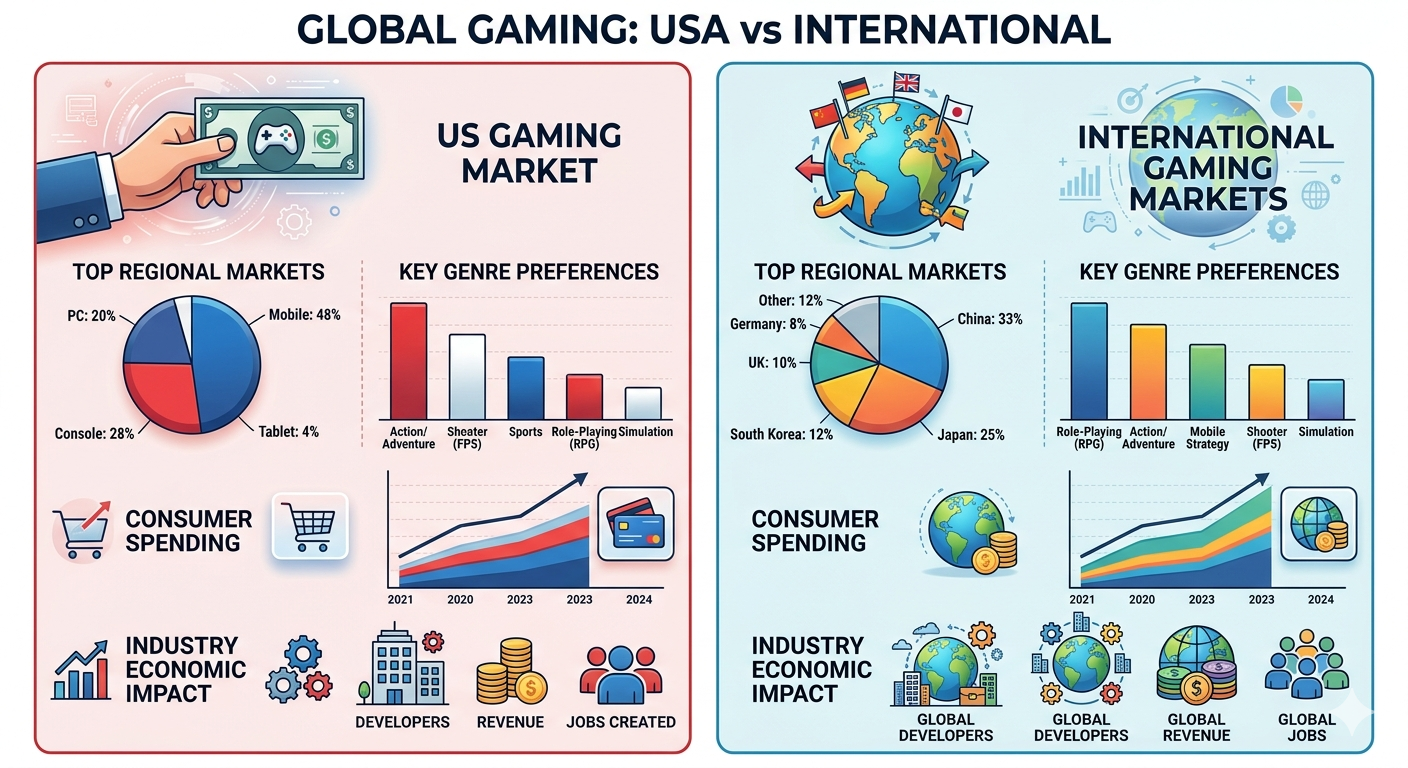
US vs. Japan: Three Key Differences in the Gaming Industry
For this comparison, I picked Japan. China gets a lot of attention, but Japan’s gaming culture is uniquely different from the US and incredibly influential.
Difference 2: Spending habits: low volume vs. high value per user.
US players spend a huge total amount, simply because the market is so large. But on a per‑user basis, Japanese gamers are among the biggest spenders in the world.
38% of Japanese mobile gamers make multiple in‑app purchases every month, and 33% spend over 10 per transaction.The Western average is around 4. Japanese players are also drawn to different motivators like narrative depth, exclusive events, and gacha mechanics (the lottery‑style system you see in games like Genshin Impact). US players are more motivated by in‑game bonuses and competitive rewards.
Difference 3: Cultural focus: global outreach vs. “Galapagos syndrome.”
US developers think globally from day one. Franchises like Call of Duty, Fortnite, and League of Legends are built for international appeal and competitive esports scenes.
Japan has historically been more closed minded– a phenomenon called “Galapagos syndrome.” The domestic market develops its own unique standards that don’t always translate well overseas. Nintendo is a big exception, but many Japanese mobile and arcade games stay Japan‑focused. Also, esports is surprisingly small in Japan (estimated $30‑65 million market) compared to the US. Japan loves playing games, but the spectator/competitive esports culture hasn’t taken off the same way.
Final Thoughts
So, is Japan’s “Galapagos” approach an asset or a liability? On one hand, it creates incredibly unique, high‑quality games that players love to spend on. On the other hand, it can limit global reach and the growth of esports.
For me, the biggest lesson from Units 3 and 4 is that business models matter as much as gameplay. Whether you’re a US esports organization or a Japanese mobile developer, relying on a single revenue stream or a single market is a risk. The smartest players in the industry diversify and think globally.
Resources
Research and Markets. (2025). The business of esports 2025. https://www.researchandmarkets.com/reports/5949745/the-business-esports
Shikenso Analytics. (n.d.). After the esports winter: The operators, teams, and strategies that survived. Retrieved May 28, 2026, from https://shikenso.com/blog/after-the-esports-winter-the-operators-teams-and-strategies-that-survived
Shikenso Analytics. (n.d.). Sports teams in esports: Sponsorship market evolution. Retrieved May 28, 2026, from https://shikenso.com/blog/sports-teams-in-esports-sponsorship-market-evolution
Smith, M. J., & Thompson, R. L. (2023). Key structure and processes in esports teams: A systematic review. Psychology of Sport and Exercise, 68(4), 1–15. https://psycnet.apa.org/record/2023-95904-001
Mistplay. (2025). 2025 mobile gaming across markets report. https://business.mistplay.com/resources/global-mobile-gaming-market-trends
eMarketer. (2025). East–west divide reshapes mobile gaming loyalty and ad strategy. https://www.emarketer.com/content/east-west-divide-reshapes-mobile-gaming-loyalty-ad-strategy
Sensor Tower. (2025). Japan’s mobile game IAP revenue surpasses $11 billion. Automaton West. https://automaton-media.com/en/news/japanese-gamers-average-gacha-spending-per-user-high-enough-to-offset-mobile-market-shrinkage-study-shows/