Unit 2
I didn't grow up with Pong, and the closest I've come to a floppy disk is seeing one in a museum. My first real gaming memory is playing Crash Bandicoot on my Game Boy and Nintendo DS, GTA, and later losing entire weekends to Dance Dance Revolution on my PS2.
But lately, I've been reading about the history of gaming, way back in the 1960s, and I found two stories that completely changed how I see the games I play today. Let me share them.
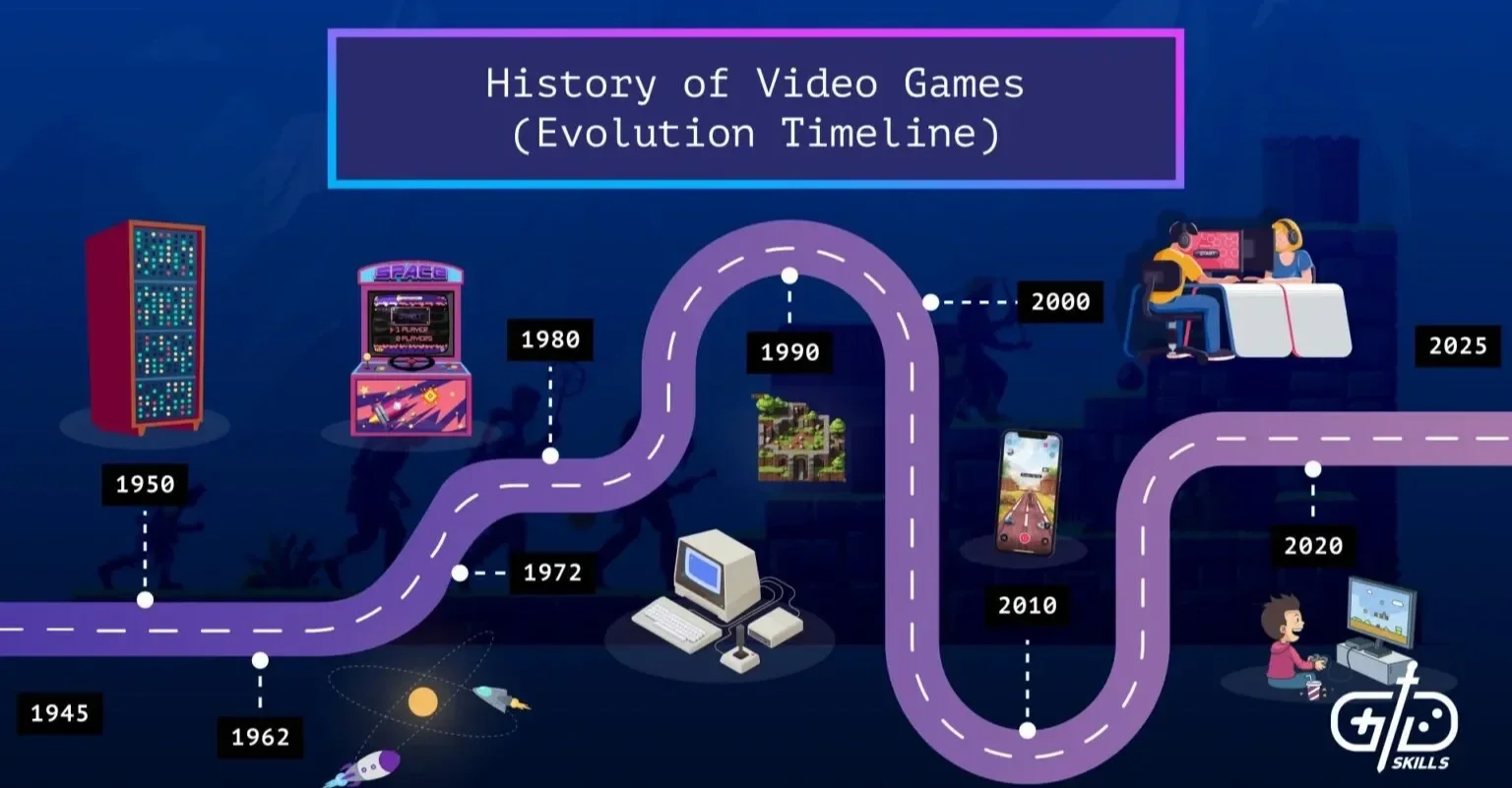
The First "Deathmatch" Happened in 1962:
Before Atari, arcades, or before anyone thought video games could make money, a group of MIT students built something called Spacewar! on a ridiculously expensive computer the size of a few mini-fridges. The screen was literally an oscilloscope. And yet, Spacewar! had two-player competitive play, a scrolling starfield background, and a "hyperspace" button that randomly teleported you away from danger.
Sound familiar? That's basically every space combat game ever. The idea of sitting next to a friend, trying to outmaneuver them, and celebrating when you land a perfect shot is a feeling that hasn't changed in over 60 years. We're just playing it on prettier screens.
I just find this amazing because it shows that great game design isn't about fancy graphics. It's about tension, competition, and joy. The people who made Spacewar! didn't have a budget or a publisher. They had curiosity and a room full of computers. That's the same energy indie developers use today to make games like Hades or Stardew Valley.
Gaming Almost Died (And Mario Saved It):
Most people don't realize that in 1983, the video game industry in North America completely collapsed. Revenue dropped by like 97%. Stores stopped selling games. People literally buried unsold cartridges in landfills. The E.T. game for Atari was so bad that it became a joke for decades.
Then Nintendo showed up, and when they released the NES in 1985, they did something smart: they put a lock on it. A physical chip that stopped unlicensed games from running. They also made developers follow strict rules and only release a few games per year. The result? Every NES game had to pass quality checks. Players began to trust the "Nintendo Seal of Quality." This is why Super Mario Bros. became a household name. It wasn't just a good game, it was proof that gaming could be reliable and fun again.
I think about this every time I open the PlayStation Store or browse Steam. Those platforms are still trying to solve the same problem: how do you let anyone make a game without letting the bad ones ruin the experience for everyone? The crash taught me that trust matters more than technology. Without Mario, I might be playing board games right now instead of Fortnite or Resident Evil.
Where Do I Fit in?
I'm a "Gen Z" gamer. I missed the arcade golden age. I never used dial-up to play Quake. My online gaming started with handheld consoles.
But the early gaming era shaped my experiences in three big ways:
The words I use – When I say "GG," or "camping," I'm speaking a language that 90s PC gamers invented because they needed to type fast in chat.
The games I love – My favorite genres (platformers, shooters, fighting games) were all figured out on primitive hardware. Playing Fortnite or Valorant feels like honoring a tradition that started with blinking green dots on a radar screen.
The way I think about failure – Early games were brutally hard because they had to be. Limited memory meant you couldn't add infinite content, so the difficulty was the replay value. Now, when I die and can’t respawn, I remind myself that this is the original design philosophy: struggle, learn, improve. No handholding.
I never lived through the pixel wars. But I'm grateful for everyone who did. They crashed, they burned, and they built something that survived. And now I get to play the remastered version.
References
Kent, S. L. (2010). The ultimate history of video games: From Pong to Pokémon and beyond – The story behind the craze that touched our lives and changed the world (2nd ed.). Three Rivers Press.
Kohler, C. (2016). Power-up: How Japanese video games gave the world an extra life. Courier Dover Publications.
Montfort, N., & Bogost, I. (2009). Racing the beam: The Atari Video Computer System. MIT Press.